
Deosai National Park Travel Guide: Everything You Need to Know Before You Visit
Plan your trip to Deosai National Park with this complete travel guide covering routes from Skardu and Astore, weather, Sheosar Lake, wildlife, camping, and essential travel tips.
Skardu ExplorersSeptember 19, 202631 min read
#Deosai National Park#Deosai Plains#Deosai National Park Pakistan#Deosai Travel Guide#Sheosar Lake#Deosai Wildlife#Deosai Brown Bear#Skardu#Astore#Gilgit-Baltistan#Northern Pakistan#Pakistan Tourism#Camping#Adventure Travel

High in the alpine highlands of Gilgit-Baltistan, Pakistan, lies one of the most astonishing high-altitude ecosystems on the planet: the vast, tree-less plateau of Deosai. Spanning over 3,000 square kilometers, this rolling expanse of emerald grass, glacial streams, and sapphire lakes sits at an average altitude exceeding 4,000 meters. Established as a protected habitat in 1993, the park serves as a crucial refuge for the endangered Himalayan brown bear, golden marmots, Tibetan wolves, and hundreds of migratory bird species.
TABLE OF CONTENTS
- Introduction
- What Is Deosai National Park?
- Where Is Deosai National Park Located?
- Why Is Deosai Called the Land of Giants?
- Deosai National Park Elevation
- Deosai National Park Weather
- Best Time to Visit Deosai National Park
- How to Reach Deosai National Park
- How Many Days Do You Need for Deosai?
- Top Places to Visit in Deosai National Park
- Deosai Wildlife and Ecosystem
- Things to Do in Deosai National Park
- Deosai National Park Travel Costs
- Where to Stay Near Deosai
- What to Pack for Deosai
- Food, Water, Fuel, and Connectivity
- Safety Tips and Altitude Sickness
- Responsible Tourism and Environmental Protection
- Suggested Deosai Itineraries
- Important Travel Tips for First-Time Visitors
- Frequently Asked Questions (FAQs)
- Final Travel Checklist
- Conclusion & Call to Action
Deosai National Park Travel Guide: Everything You Need to Know Before You Visit
Introduction
High in the alpine highlands of Gilgit-Baltistan, Pakistan, lies one of the most astonishing high-altitude ecosystems on the planet: the vast, tree-less plateau of Deosai. Spanning over 3,000 square kilometers, this rolling expanse of emerald grass, glacial streams, and sapphire lakes sits at an average altitude exceeding 4,000 meters. Established as a protected habitat in 1993, the park serves as a crucial refuge for the endangered Himalayan brown bear, golden marmots, Tibetan wolves, and hundreds of migratory bird species.
Navigating this remote wilderness requires thorough planning, accurate route knowledge, and an understanding of extreme mountain weather. This comprehensive Deosai National Park Travel Guide is designed to provide you with everything necessary to execute a safe, memorable, and responsible expedition. From selecting the ideal seasonal window and securing 4x4 transport to setting up camp under pristine, unpolluted night skies, this guide delivers actionable, field-tested advice for international travelers, domestic adventurers, families, and wildlife photographers alike.
What Is Deosai National Park?
Featured Snippet Answer:
Deosai National Park is a high-altitude alpine plain and protected national park located in Gilgit-Baltistan, Pakistan. Recognized as the world's second-highest plateau (average elevation 4,114 meters), it covers approximately 3,000 square kilometers and is famous for its wildflower blooms, glacial lakes like Sheosar Lake, and protection of the endangered Himalayan brown bear.
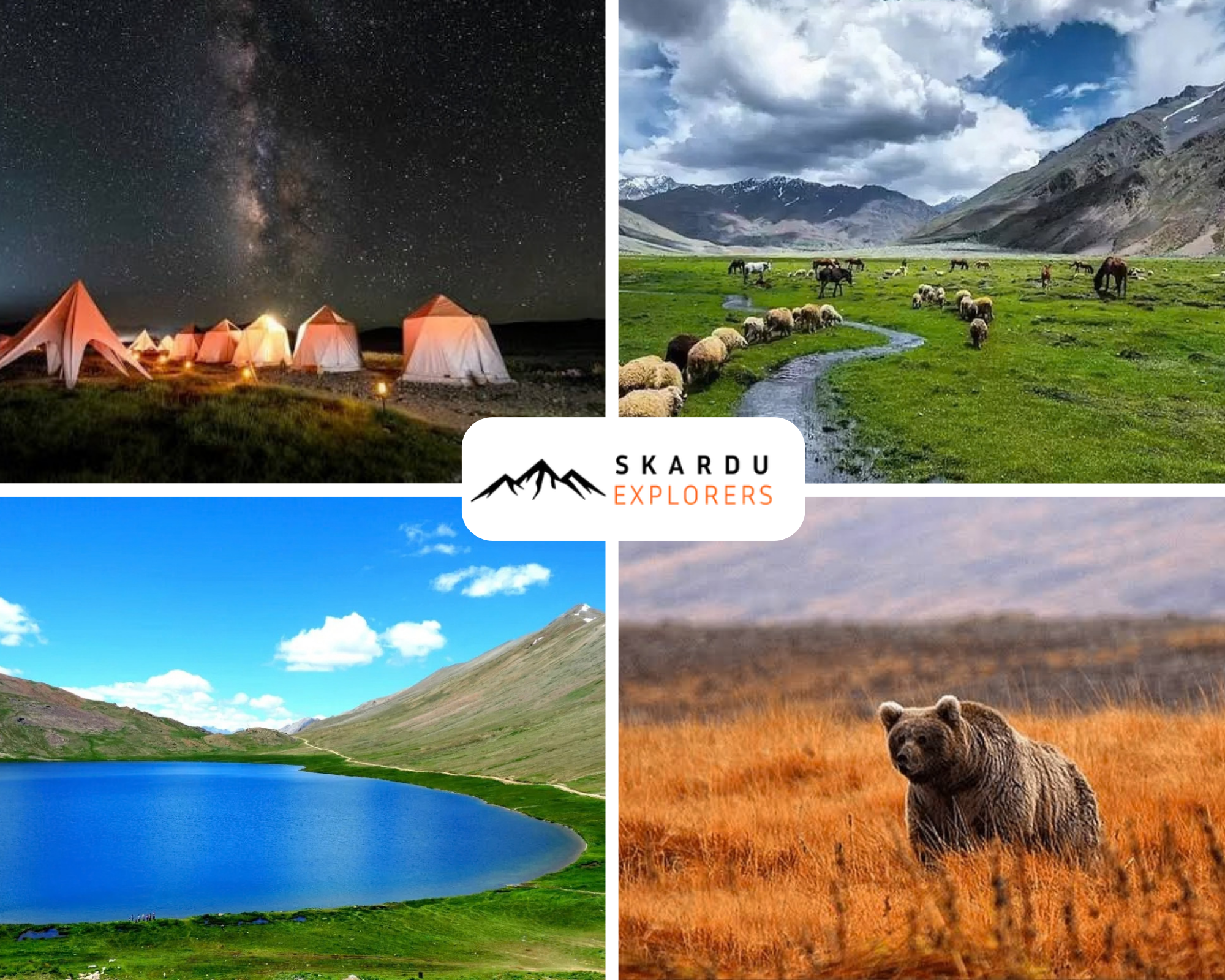
In the local Balti language, Deosai is known as Ghbiarsa, which translates directly to "Summer's Place." This name reflects its seasonal reality: for roughly eight to nine months of the year, the plateau is buried under heavy snow, completely frozen and uninhabited. During the brief summer window from June to September, the ice melts, transforming a harsh arctic wilderness into a lush alpine meadow blanketed with thousands of colorful wildflower species.
The park represents a unique ecological bridge between the Western Himalayas and the Karakoram range. Because of its ecological fragility, permanent human settlements are prohibited within park boundaries. Facilities are limited to seasonal wildlife ranger posts and designated eco-camping sites during the summer months.
Where Is Deosai National Park Located?
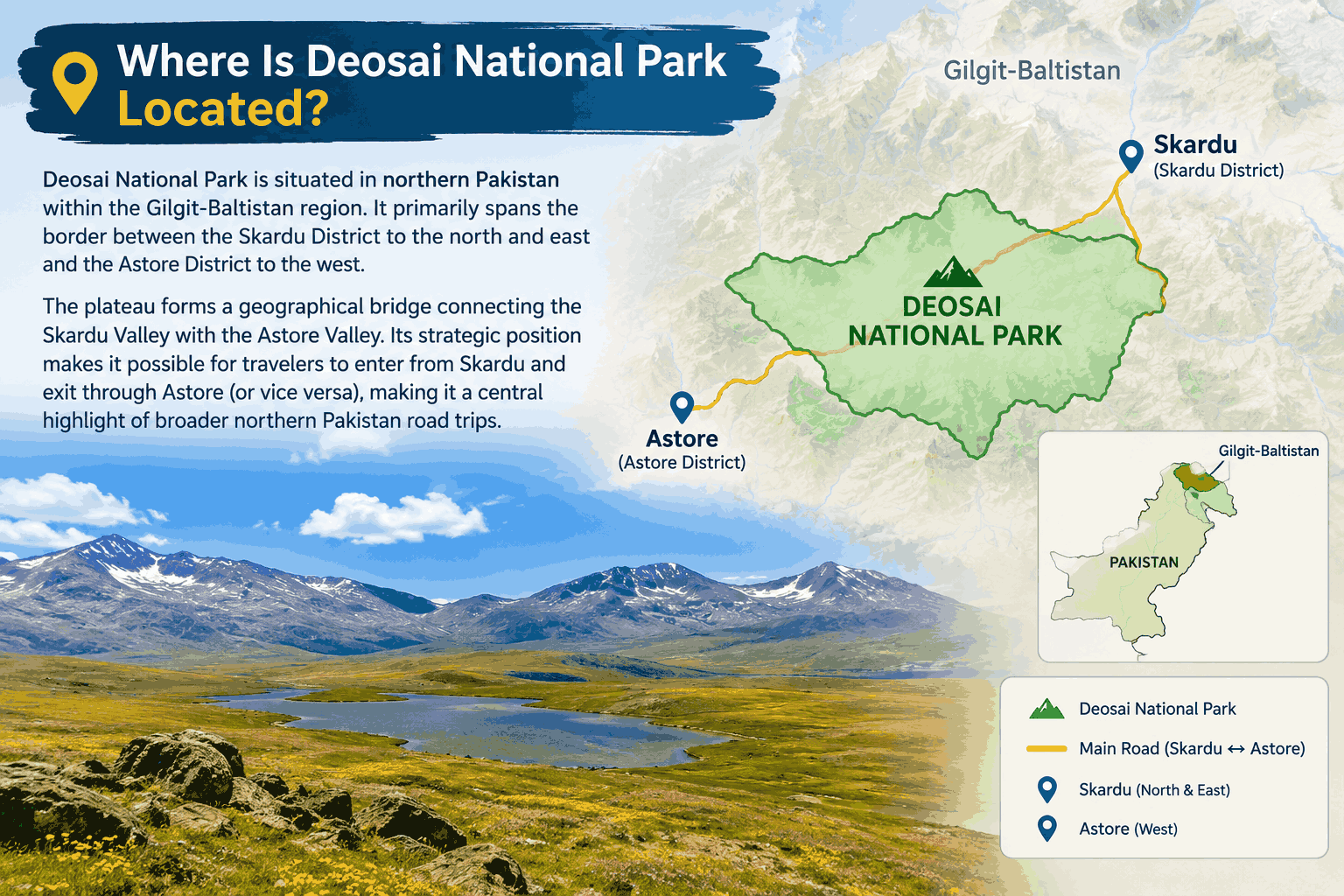
Deosai National Park is situated in northern Pakistan within the Gilgit-Baltistan region. It primarily spans the border between the Skardu District to the north and east and the Astore District to the west.
The plateau forms a geographical bridge connecting the Skardu Valley with the Astore Valley. Its strategic position makes it possible for travelers to enter from Skardu and exit through Astore (or vice versa), making it a central highlight of broader northern Pakistan road trips.
Why Is Deosai Called the Land of Giants?
The name "Deosai" originates from folk legends and local folklore, combining the Urdu words Deo (giant) and Sai (shadow or place), literally translating to "The Shadow of the Giant" or "The Land of Giants."
Historically, indigenous populations believed the high plateau was inhabited by supernatural giants due to its colossal scale, eerie silence, unpredictable mountain storms, and complete absence of human habitation. The vast, endless horizon—where rolling green hills meet the sky without a single tree in sight—gives travelers an overwhelming sense of stepping into a prehistoric realm where humans are merely visitors in a domain ruled by nature and wild beasts.
Deosai National Park Elevation
The Deosai Plains sit at an average elevation of 4,114 meters (13,497 feet) above sea level. Elevation within the park fluctuates between 3,500 meters at lower valley access points to over 4,250 meters near surrounding ridge passes and Sheosar Lake.
| Location / Point of Interest | Approximate Elevation (Meters) | Approximate Elevation (Feet) |
|---|---|---|
| Skardu Town (Base City) | 2,228 m | 7,310 ft |
| Ali Malik Mar Pass (Skardu Entrance) | 4,300 m | 14,107 ft |
| Bara Pani Campsite | 4,020 m | 13,188 ft |
| Sheosar Lake | 4,142 m | 13,589 ft |
| Chilam Top (Astore Entrance) | 3,800 m | 12,467 ft |
Because the plateau rests comfortably above the tree line, visitors experience reduced atmospheric pressure and lower oxygen concentration compared to lower valleys like Skardu or Hunza. Proper acclimatization is mandatory before undertaking strenuous activity here.
Deosai National Park Weather
The atmospheric conditions across Deosai are extreme, highly volatile, and subject to sudden shifts within minutes. Even during peak summer (July and August), daytime temperatures rarely exceed 18°C to 20°C (64°F to 68°F), while nighttime temperatures frequently hover near or drop below freezing (0°C / 32°F).
| Season | Months | Temperature Range (°C) | Weather Conditions & Accessibility |
|---|---|---|---|
| Summer (Peak) | July – August | 5°C to 20°C (Day) -2°C to 5°C (Night) |
Green meadows, peak wildflowers, clear roads, optimal wildlife sightings. |
| Autumn (Late) | September | 0°C to 14°C (Day) -5°C to 0°C (Night) |
Golden landscapes, crisp skies, cooler winds, thinning crowds. Roads close late Sept/Oct. |
| Winter & Spring | October – May | -25°C to -10°C | Heavy snow cover, sub-zero conditions, high avalanche risk. Completely closed. |
Sub-zero wind chills, intense UV exposure, sudden rain, hail, and localized blizzards can occur even in mid-July. Travelers must come prepared with full cold-weather gear regardless of how warm and sunny it feels when departing Skardu or Astore.
Best Time to Visit Deosai National Park
Featured Snippet Answer:
The best time to visit Deosai National Park is from mid-July to late August. During this brief window, the snow fully thaws, tracks open to 4x4 vehicles, wildflowers bloom across the plains, and temperatures are mildest. September offers golden autumn scenery with fewer tourists before winter snow closes the park.
      DEOSAI VISITATION WINDOW
┌────────────────────────────────────────────────────────┐
│ MAY - JUNE   : Snowmelt Begins / Tracks Clearing       │
│ JUL - AUG    : PEAK SEASON (Wildflowers & Wildlife)    │ ★ RECOMMENDED
│ SEPTEMBER    : Autumn Colors / Cooler Nights           │
│ OCT - APRIL  : CLOSED (Heavy Snow & Frozen Plateau)    │
└────────────────────────────────────────────────────────┘
- July to Early August (Wildflower Peak): The plateau comes alive with millions of wildflowers (including blue poppies, gentians, and saxifrages). Streams run full, and wildlife activity is high.
- Late August to Mid-September (Quiet & Clear): The summer green shifts toward warm golden hue. Skies are crisp and ideal for landscape photography, though nighttime temperatures decline sharply.
- Winter (October to June): The park is inaccessible to vehicles and closed to standard tourism due to feet of snow accumulation and severe arctic conditions.
How to Reach Deosai National Park
Featured Snippet Answer:
To reach Deosai National Park, travelers generally start from Skardu or Astore in Gilgit-Baltistan. Accessible only by high-clearance 4x4 vehicles (such as Toyota Land Cruisers or Jeeps) due to unpaved, rocky mountain tracks, the drive takes approximately 2 to 2.5 hours from Skardu via Sadpara Dam.
Reaching Deosai requires driving on mountain roads and dirt tracks. Standard sedans or low-clearance passenger cars cannot handle the steep gradients, rocky river crossings, and rough terrain. Hiring an experienced local 4x4 driver is strongly recommended.
               [ ISLAMABAD ]
                     │
         ┌───────────┴───────────┐
         ▼                       ▼
    (1-Hr Flight)          (20-24 Hr Drive)
         │                       │
         ▼                       ▼
    [ SKARDU ]           [ KARAKORAM HWY / ASTORE ]
         │                       │
   (2 Hours / 4x4)         (3 Hours / 4x4)
         │                       │
         └───────────┬───────────┘
                     ▼
       [ DEOSAI NATIONAL PARK ]
Route Comparison Table
| Feature | Skardu to Deosai Route | Astore to Deosai Route |
|---|---|---|
| Starting Point | Skardu City | Astore Town / Gorikot |
| Primary Checkpoint | Ali Malik Mar or Sadpara Gate | Chilam Checkpost |
| Distance to Park Center | ~45 km to Bara Pani | ~70 km to Sheosar Lake |
| Travel Time | 2 to 2.5 hours | 3 to 3.5 hours |
| Road Conditions | Asphalt to Sadpara Lake, then unpaved 4x4 dirt track | Mixed asphalt and rough unpaved mountain track |
| Key Landmarks | Sadpara Lake, Ali Malik Pass, Bara Pani | Chilam Valley, Sheosar Lake |
| Vehicle Required | High-Clearance 4x4 Jeep / SUV | High-Clearance 4x4 Jeep / SUV |
Deosai National Park From Skardu
The route from Skardu is the most popular, accessible, and direct way to enter Deosai National Park.
- Skardu to Sadpara Lake (15 km | ~30 mins): Smooth paved road passing through southern Skardu up toward the clear waters of Sadpara Lake.
- Sadpara Lake to Ali Malik Mar Pass (20 km | ~1 hour): The asphalt ends, giving way to a steep, winding, switchback dirt road ascending rapidly toward Ali Malik Mar Pass (4,300m).
- Ali Malik Pass to Bara Pani (10 km | ~45 mins): Descending slightly onto the rolling plateau itself, leading directly to the central wildlife ranger station and designated camping grounds at Bara Pani.
Deosai National Park From Astore
Entering Deosai from the Astore side is ideal for travelers doing a traverse from Hunza/Gilgit toward Skardu without doubling back.
- Astore Valley to Gorikot & Chilam (55 km | ~2 hours): The drive proceeds through narrow mountain valleys along the Astore River up to Chilam village, the last permanent settlement on this side.
- Chilam to Sheosar Lake (15 km | ~1 hour): From the Chilam park checkpost, the track climbs steadily onto the southwestern boundary of the plateau, reaching Sheosar Lake first before proceeding toward Bara Pani and Skardu.
How Many Days Do You Need for Deosai?
Featured Snippet Answer:
You need at least 1 full day (a day trip) to see major highlights like Sheosar Lake and Bara Pani from Skardu. However, spending 2 days and 1 night (camping) is highly recommended to experience sunrise, sunset, stargazing, and increase your chances of spotting Himalayan brown bears.
- 1 Day (Day Trip): Departs Skardu early morning (7:00 AM), reaches Bara Pani and Sheosar Lake, and returns by evening. Fast-paced, but covers main vistas.
- 2 Days / 1 Night (Recommended): Allows overnight camping at Bara Pani or Sheosar Lake. Offers ideal dawn and dusk lighting for photography and optimal timing for brown bear spotting.
- 3 Days / 2 Nights (Extended Wilderness): Perfect for photography enthusiasts, hikers, anglers, and travelers traversing from Astore through to Skardu with extra time for side treks toward Shatung.
Top Places to Visit in Deosai National Park
 ┌─────────────────────────────────────────────────────────┐
 │               DEOSAI NATIONAL PARK MAP                  │
 │                                                         │
 │  (North / Skardu)                                       │
 │        │                                                │
 │        ▼                                                │
 │   [Ali Malik Mar Pass] (4,300m)                         │
 │        │                                                │
 │        ▼                                                │
 │   [Bara Pani] ──────► [Shatung Nullah]                  │
 │        │              (Bear Observation Zone)           │
 │        ▼                                                │
 │   [Kala Pani]                                           │
 │        │                                                │
 │        ▼                                                │
 │   [Sheosar Lake] (4,142m)                               │
 │        │                                                │
 │        ▼                                                │
 │   [Chilam / Astore Exit]                                │
 └─────────────────────────────────────────────────────────┘
Sheosar Lake
Sheosar Lake (often called "Blind Lake" locally) is an alpine lake sitting at an altitude of 4,142 meters. With a depth averaging 40 meters, its deep turquoise waters mirror the surrounding snow-capped peaks of the Western Himalayas. On clear days, the distant crest of Nanga Parbat ($8,126\text{ m}$) can be seen framing the horizon behind the lake.
Bara Pani and Kala Pani
Bara Pani (Big Water) and Kala Pani (Black Water) are the two primary river channels crossing the Deosai plateau.
- Bara Pani: Serves as the primary administrative hub for park rangers and the main official camping site. It features a wooden suspension bridge (and a vehicle bridge for 4x4s). The surrounding wetlands host golden marmots and abundant birdlife.
- Kala Pani: Located a short drive south of Bara Pani, named for its dark, clear riverbed sediments and cold snowmelt stream.
Deosai Plains Meadows
The vast, undulating grasslands constitute the core experience of Deosai. Spanning tens of kilometers without trees, these alpine meadows are carpeted with yellow, purple, blue, and white flowers in mid-summer, intersected by small freshwater trickles and marmot burrows.
Shatung Nullah
Shatung Nullah is a quieter, side valley extending off the main track near Bara Pani. Known for cold glacial streams and alpine wetlands, it is considered one of the primary foraging zones for Himalayan brown bears during early mornings and late afternoons.
Deosai Wildlife and Ecosystem
Deosai National Park is an ecological refuge surrounded by severe topography. The absence of permanent human settlement has preserved a high-altitude sanctuary for several rare endemic species.
              ┌──────────────────────────────┐
              │    DEOSAI KEY WILDLIFE       │
              └──────────────┬───────────────┘
                             │
     ┌───────────────────────┼───────────────────────┐
     ▼                       ▼                       ▼
[Himalayan Brown Bear]  [Golden Marmot]       [Avian Species]
~75-80 Individuals     Abundant Across      Golden Eagles, Lammergeiers,
Protected Status       Meadows               Snowcocks, Migratory Ducks
The Himalayan Brown Bear
The Himalayan brown bear (Ursus arctos isabellinus) is the undisputed flagship species of Deosai.
- Conservation History: In 1993, when the park was formed, fewer than 20 bears survived due to poaching and habitat encroachment. Dedicated ranger protection and strict travel guidelines have allowed the population to stabilize to an estimated 75–80 individuals.
- Behavior & Diet: These bears are omnivorous, feeding on alpine roots, grasses, golden marmots, plants, and occasional fish. They enter winter hibernation in burrows dug into higher mountain slopes around October and emerge in May/June.
- Observation Etiquette: Maintain a distance of at least 150 to 200 meters. Never approach on foot. Keep food tightly sealed inside vehicles or designated storage at campsites to avoid habituating bears to human garbage.
Other Wildlife and Avian Species
- Golden Marmot (Marmota caudata): Ubiquitous across the plateau. Highly vocal, popping out of ground burrows with shrill alarm whistles when hawks, eagles, or humans approach.
- Mammals: Tibetan wolf (Canis lupus chanco), Himalayan ibex, Red fox, and Ladakh urial occupy higher rocky crests surrounding the plateau.
- Birdlife: Over 120 bird species have been recorded, including resident golden eagles, lammergeiers (bearded vultures), Himalayan snowcocks, Eurasian kestrel, and seasonal migratory waterfowl landing on Sheosar Lake.
Things to Do in Deosai National Park
Camping in Deosai
Overnight camping on the high plateau is one of Pakistan's most memorable outdoor experiences. Designated camping areas exist at Bara Pani and Sheosar Lake, managed in coordination with local park authorities and community eco-tourism operators.
- Facilities: Basic setup with designated tent platforms and eco-friendly pit toilets.
- Temperature Warning: Expect night temperatures to plunge to around $0^\circ\text{C}$ to $-5^\circ\text{C}$, even in July. High-grade four-season sleeping bags, insulated sleeping pads, and windproof tents are required.
Photography and Wildlife Watching
With pristine atmospheric clarity and low light pollution, Deosai is a paradise for photography.
- Landscape Photography: Golden hour (5:30 AM – 7:00 AM and 5:30 PM – 7:00 PM) highlights the texture of rolling green hills against cold glacial streams.
- Wildlife Photography: Telephoto lenses ($300\text{mm}$ to $600\text{mm}$) are essential for capturing brown bears and golden marmots safely from a respectful distance.
Stargazing
At an altitude above 4,000 meters away from urban light sources, Deosai offers unhindered views of the night sky. On clear, moonless nights, the Milky Way core is visible to the naked eye with extraordinary sharpness.
Angling and Fishing
Snow trout (Schizothorax) inhabit the cold waters of Bara Pani and Shatung stream.
- Permit Required: Angling is regulated. Fishermen must obtain a seasonal/daily fishing permit from the Wildlife Department checkpost at Bara Pani or Skardu. Catch-and-release practices are encouraged.
Deosai National Park Travel Costs
Note: All prices are estimates based on regional averages and subject to currency fluctuations and fuel cost updates. Always verify current local rates before departure.
| Service / Expense Category | Estimated Cost (PKR) | Estimated Cost (USD) | Notes |
|---|---|---|---|
| Park Entry Fee (Foreigners) | ~PKR 3,000 - 4,000 / person | ~$10 - $15 | Paid at entrance checkposts (Ali Malik / Chilam) |
| Park Entry Fee (Domestic) | ~PKR 200 - 500 / person | ~$1 - $2 | Paid at entrance checkposts |
| 4x4 Jeep Hire (Day Trip from Skardu) | PKR 18,000 - 25,000 | ~$65 - $90 | Includes driver & fuel; covers round trip to Sheosar |
| 4x4 Jeep Hire (Overnight / 2 Days) | PKR 30,000 - 40,000 | ~$110 - $145 | Covers driver allowance, fuel, overnight wait fee |
| Campsite Rent (Tent + Mat) | PKR 2,500 - 5,000 / night | ~$9 - $18 | Available at Bara Pani / Sheosar seasonal camps |
| Local Guide (Optional) | PKR 3,000 - 5,000 / day | ~$11 - $18 | Highly recommended for bear watching / safety |
Where to Stay Near Deosai
 ┌─────────────────────────────────────────────────────────────────┐
 │                     ACCOMMODATION OPTIONS                       │
 └─────────────────────────────────────────────────────────────────┘
         │                                           │
         ▼                                           ▼
 [OVERNIGHT ON PLATEAU]                     [BASE IN NEARBY TOWNS]
  • Seasonal Tented Camps                    • Skardu (Luxury Hotels & Resorts)
  • Personal Camping (Bara Pani/Sheosar)     • Astore / Rama Valley (Guesthouses)
- Camping on the Plateau (Bara Pani / Sheosar Lake): Best for true wilderness exposure. Seasonal tent villages operate from late June through August, renting pre-erected tents with basic bedding, or you can pitch your own equipment at designated sites.
- Hotels in Skardu City (2 Hours Away): Ideal for families or travelers requiring modern comforts, warm baths, heating, and full dining options. You can take day trips into Deosai while returning to hotel comfort in Skardu every evening.
- Guesthouses in Astore / Rama Valley (2.5–3 Hours Away): Provides a quiet base on the western side of the park, ideal if traveling toward Gilgit or the Karakoram Highway.
What to Pack for Deosai
Due to rapid weather shifts and extreme altitudes, packing the right gear is critical for safety and comfort.
       PACKING CATEGORIES
┌───────────────────────────────┐
│ 1. THERMAL & WEATHERPROOF GEAR│
│ 2. ALTITUDE & SUN PROTECTION  │
│ 3. NAVIGATION & POWER BACKUP  │
│ 4. HYGIENE & WASTE MANAGEMENT │
└───────────────────────────────┘
Essential Clothing Layering System
- Base Layer: Thermal innerwear (merino wool or synthetic).
- Mid Layer: Fleece jacket or lightweight down sweater.
- Outer Shell: Windproof and waterproof hard-shell jacket with hood.
- Pants: Quick-dry trekking trousers (plus thermal bottoms for evening).
- Footwear: Sturdy, waterproof hiking boots with ankle support.
Outdoor & Personal Gear
- Sleeping Bag: Comfort rating down to $-5^\circ\text{C}$ or lower (if camping).
- Sun Protection: High SPF sunscreen (50+), UV-blocking sunglasses, wide-brim hat.
- Hydration: Reusable water bottles and water purification tablets/filters.
- Electronics: High-capacity power banks (battery life drops fast in cold temperatures).
- First Aid: Personal medications, pain relievers, band-aids, and altitude sickness medication (e.g., Acetazolamide / Diamox—consult your physician before use).
Food, Water, Fuel, and Connectivity
- Food & Dining: Basic seasonal tea stalls at Bara Pani and Sheosar Lake sell hot chai, instant noodles, boiled eggs, and simple dal-rice meals during peak summer. All specialized snacks, high-calorie energy bars, canned goods, and fresh fruit should be purchased in Skardu or Astore beforehand.
- Drinking Water: Do not consume untreated surface water from streams due to grazing livestock upstream. Always filter, boil, or use purification tablets on natural spring water.
- Fuel Stations: There are NO fuel pumps anywhere inside Deosai National Park. Top up your vehicle fuel tank completely in Skardu Town or Astore/Gorikot before ascending.
- Mobile Connectivity: Mobile network coverage (SCOM, Telenor, Zong, Jazz) is extremely limited or non-existent once you cross Ali Malik Mar Pass or Chilam checkpost. Expect total digital disconnection across 95% of the plateau. Carry a satellite communicator or inform hotel management/family of your expected return time.
Safety Tips and Altitude Sickness
Acute Mountain Sickness (AMS) is a real risk when ascending rapidly from Skardu ($2,200\text{ m}$) or Islamabad ($500\text{ m}$) up to Deosai ($4,100+\text{ m}$).
   PREVENTING ALTITUDE SICKNESS (AMS) AT 4,000m+
┌──────────────────────────────────────────────────┐
│  • Spend at least 24 hours in Skardu to adapt    │
│  • Drink 3 to 4 liters of water daily            │
│  • Avoid alcohol and heavy overexertion          │
│  • Descend immediately if severe symptoms persist│
└──────────────────────────────────────────────────┘
- Acclimatize First: Spend at least 24–48 hours in Skardu or Astore before sleeping overnight on the Deosai plateau.
- Hydrate Continuously: High altitude accelerates dehydration. Drink 3–4 liters of fluids daily.
- Recognize Symptoms: Headache, nausea, dizziness, and shortness of breath are early signals of AMS. If symptoms worsen, descend to lower elevation immediately.
- Wildlife Safety: Keep a safe distance from Himalayan brown bears. Never walk alone into deep meadows or brush at night; stay near designated camp zones.
Responsible Tourism and Environmental Protection
Deosai's alpine tundra ecosystem is fragile. Topsoil takes decades to form, and alpine vegetation recovers slowly from damage.
- Pack It In, Pack It Out: Carry every piece of plastic, wrapper, and personal trash back to Skardu or Astore for proper disposal.
- No Off-Road Driving: Strictly instruct your driver to stay on marked 4x4 tracks. Driving off-track destroys delicate root systems and marmot habitat.
- Fire Restrictions: Do not cut alpine shrubs or build open bonfires on the ground. Use portable gas stoves for cooking at designated campsites.
- Respect Wildlife: Do not fly drones low over wildlife. Avoid making loud noises or throwing food near bears or marmots.
Suggested Deosai Itineraries
2-Day Express Itinerary
Ideal for travelers short on time who want to experience overnight camping on the plateau.
 DAY 1: Skardu ──► Sadpara Lake ──► Ali Malik Pass ──► Bara Pani (Camp)
 DAY 2: Bara Pani ──► Sheosar Lake ──► Return to Skardu
- Day 1:
- 08:00 AM – Depart Skardu in a rented 4x4 Jeep.
- 09:00 AM – Photo stop at Sadpara Lake.
- 11:30 AM – Cross Ali Malik Mar Pass; arrive at Bara Pani campsite.
- 02:00 PM – Lunch and afternoon hike around Shatung Nullah stream (wildlife observation).
- 06:00 PM – Sunset photography, dinner, and overnight camping at Bara Pani.
- Day 2:
- 05:30 AM – Early morning game drive / walk for potential bear and marmot sightings.
- 09:00 AM – Breakfast and drive south toward Sheosar Lake.
- 11:00 AM – Explore Sheosar Lake shore, picnic lunch, and photography.
- 02:30 PM – Begin return drive back to Skardu via Ali Malik Mar Pass.
- 06:00 PM – Arrive back in Skardu City.
3-Day Comprehensive Itinerary
Ideal for photographers, nature lovers, and travelers traversing from Skardu to Astore.
| Day | Destination / Route | Key Highlights & Activities | Overnight Location |
|---|---|---|---|
| Day 1 | Skardu to Bara Pani | Ascend via Sadpara Lake, cross Ali Malik Pass, explore northern plateau, afternoon stream walk. | Bara Pani Campsite |
| Day 2 | Bara Pani to Sheosar Lake | Early morning bear observation at Shatung stream, drive across central plains, afternoon at Sheosar Lake, night stargazing. | Sheosar Lake Campsite |
| Day 3 | Sheosar Lake to Astore / Rama | Sunrise photos at Sheosar Lake, descend through Chilam Checkpost into Astore Valley, visit Rama Lake. | Rama Valley / Astore |
Important Travel Tips for First-Time Visitors
- Cash is Essential: There are no ATMs or electronic card machines anywhere on the plateau. Bring sufficient Pakistani Rupees (PKR) in cash for vehicle hire, entry fees, camping, and food.
- Start Drives Early: Weather on high plateaus often deteriorates in the late afternoon with sudden rain or wind storms. Plan your road transfers for early mornings.
- Dress in Layers: Temperatures fluctuate rapidly between direct sunlight ($18^\circ\text{C}$) and shade/clouds ($5^\circ\text{C}$).
- Prepare Vehicles: Check that your 4x4 Jeep has a functional spare tire, jack, tool kit, and adequate fuel reserve before leaving Skardu or Astore.
Frequently Asked Questions
What is the best month to visit Deosai?
The absolute best months are July and August. During this time, the snow has fully melted, roads are clear, wildflowers cover the meadows, and temperatures are most comfortable for travel and camping.
Is Deosai open throughout the year?
No. Deosai National Park is closed for approximately eight to nine months of the year due to heavy snow accumulation. It is generally open only from mid-June to late September or early October.
How do I reach Deosai from Skardu?
You can reach Deosai from Skardu by hiring a 4x4 vehicle (Jeep or Land Cruiser). The route heads south past Sadpara Lake, ascends Ali Malik Mar Pass, and drops onto the plateau at Bara Pani. The drive takes about 2 to 2.5 hours.
Can I visit Deosai from Astore?
Yes. You can enter Deosai from Astore via Gorikot and Chilam village. The road climbs up to Chilam Checkpost and reaches Sheosar Lake first before proceeding toward Bara Pani and Skardu.
How many days are needed for Deosai?
A 1-day trip is sufficient for a quick tour of major spots, but 2 days and 1 night is recommended to camp, enjoy stargazing, and see wildlife during dawn and dusk hours.
Is camping allowed in Deosai?
Yes, camping is permitted at designated areas such as Bara Pani and Sheosar Lake. Visitors must bring four-season cold-weather gear or rent basic tents from seasonal camps set up on-site.
Can I see the Himalayan brown bear?
Yes, but sightings are not guaranteed. An estimated 75 to 80 brown bears inhabit the park. Your best chance of seeing them is early morning or late afternoon near quiet stream channels like Shatung Nullah with the help of an experienced local guide.
Is Deosai suitable for families?
Yes, Deosai is suitable for families, provided all members (especially young children and elderly adults) are well-prepared for cold weather, high altitude, rough 4x4 rides, and basic washroom facilities.
What should I pack for Deosai?
Essential items include thermal base layers, a windproof/waterproof jacket, sturdy hiking boots, a cold-rated sleeping bag (if camping), high-SPF sunscreen, sunglasses, power banks, cash, and personal medications.
Is there mobile network coverage in Deosai?
No. Mobile network coverage is virtually non-existent once you enter the core national park area. Plan for a complete digital detox and inform family before ascending.
Do I need a 4x4 vehicle to go to Deosai?
Yes. Standard sedans, low-clearance cars, and small hatchbacks cannot handle the steep, unpaved, rocky tracks and water crossings. A high-clearance 4x4 vehicle is mandatory.
Is Deosai safe for international tourists?
Yes, Deosai National Park is considered safe for domestic and international travelers. Park rangers monitor the checkposts and grounds continuously. Standard high-altitude outdoor safety precautions apply.
Final Travel Checklist
- High-clearance 4x4 Jeep booked with an experienced driver.
- Vehicle fuel tank completely filled in Skardu or Astore.
- Sufficient cash in Pakistani Rupees (PKR) for fees, food, and tipping.
- Thermal base layers, fleece mid-layers, and waterproof outer jacket.
- Cold-rated sleeping bag (comfort down to $-5^\circ\text{C}$ if camping).
- High-SPF sunscreen, lip balm, and UV sunglasses.
- Portable high-capacity power bank for electronics.
- Personal first-aid kit with altitude sickness and pain relief medication.
- Drinking water purification tablets or portable water filter.
- Trash bags to pack out all waste and plastic.
Conclusion
Deosai National Park is one of the world's extraordinary natural landscapes—a vast alpine plateau where rolling green meadows touch the sky and rare wildlife roams free. Whether you come to witness the vibrant summer wildflower bloom, camp under bright starry skies, search for the elusive Himalayan brown bear, or stand beside the sapphire waters of Sheosar Lake, Deosai delivers an unforgettable adventure.
By planning your trip between July and September, securing reliable 4x4 transportation, respecting high-altitude safety guidelines, and adhering to strict Leave No Trace environmental standards, you ensure that this delicate ecosystem remains pristine for generations to come. Plan your journey responsibly, double-check local road and weather conditions before departing, and prepare to discover Pakistan's majestic "Land of Giants."
Written by
Skardu Explorers
You Might Also Like

Never Miss an Adventure
Explore every travel guide, trek report, and photography story we publish for Skardu and the wider Karakoram.
Browse All Guides